Archives: SFW In Action
SFW Welcomes Oz and Tig of “13 Hours: Benghazi”
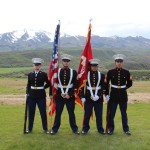
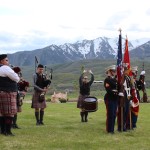
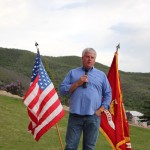
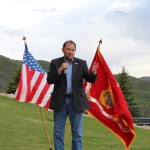
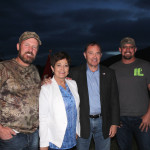
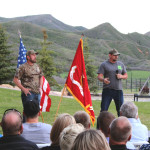
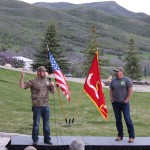
Two of the six Secret Soldiers of Benghazi, Mark “Oz” Geist and John “Tig” Tiegen, joined SFW, Utah Governor Gary Herbert and Hunts for the Brave on May 14th for a very special evening honoring America’s war veterans and remembering the truth behind the movie “13 Hours”.
It was incredible to hear first-hand about the challenges they faced the details of exactly how Ambassador Chris Stevens died and how they felt they could have saved him if they would have been given permission to go when it all started. Oz rehearsed the injuries he suffered in the battle and being on the roof that took the lives of two soldiers, He also replayed the emotion experienced in the aftermath.
These men were told to stand down by those in command while Americans were being killed. They ignored that command and fought for many lives, including their own. Oz and Tig are incredible men, true patriots and great American heroes. The unmatched scenery of the South Wasatch Back from the beautiful home of Tom Mower made the perfect setting for an unforgettable event.

UPDATE: Utah Big Game Captures and Transplants
A Message to SFW from UDWR Big Game Program Coordinator Justin M Shannon
Here is a summary of the big game captures/transplants that took place this past fall/winter. Overall, we captured 1,276 big game animals this year.
I want to thank all of you who helped with the captures. Many of you contributed time, money, and efforts to make these captures happen, and we appreciate it. There is a lot of momentum in Utah’s big game program right now, and I believe it is because of the strong partnerships we have with sportsmen and our great biologists. I also want to thank Kent Hersey for taking the lead on organizing these projects, Brock and Randy from BYU for all the great research they are doing, Bill Bates and our Director’s Office for their continued support, and the project leaders and safety officers for carrying out the captures in a safe and professional manner.

This radio collared bighorn ewe was photographed near Moab, Utah in Arches National Park. Photo by Phil Douglass, Utah Division of Wildlife Resources
Bighorn Sheep – 142 animals
Disease profiling and monitoring
Zion – 16 animals
San Juan – 18 animals
Dirty Devil – 19 animals
Stansbury – 21 animals
Avintaquin – 7 animals
Transplants
12 sheep were transplanted from Zion to Pine Valley
49 sheep were transplanted from Antelope Island to Oak Creek

Mountain Goats – 21 animals were transplanted from Willard Peak to Mt Dutton
Bison – 15 bison were captured and disease tested on the Book Cliffs

The helicopter brings a captured bison to the handling area on the Henry Mountains. Photo taken 1-10-09 by Bill Bates, Utah Division of Wildlife Resources
Elk – 259 animals
189 elk (144 cows, 45 bulls) were captured as part of the Wasatch elk study
30 cow elk were captured in the Southern Region (10 on Southwest Desert, 10 on Panguitch Lake, and 10 on Beaver) to monitor movement patterns
6 collars were deployed on the San Juan Unit
34 animals from Park City to other portions of the Wasatch unit

Deer – 839 animals
Survival monitoring – 548
Pine Valley (40 does and 20 fawns in December, 23 does in March)
Wasatch/Manti (40 does and 20 fawns in December, 21 does in March)
Oquirrh-Stansbury (29 does and 20 fawns in December, 21 does in March)
Cache (40 does and 20 fawns in December, 21 does in March)
South Slope (21 does and 20 fawns in December, 13 does in March)
San Juan (41 does and 20 fawns in December, 26 does in March)
Monroe (30 does and 20 fawns in December, 20 does in March)
Vernon (22 does captured to monitor migration patterns)
Urban deer – 291 animals
94 animals from Bountiful to Big Wash
93 animals from Bountiful to Raft River
69 animals from Bountiful to the southeast Manti
2 animals from Bountiful to East Canyon WMA
32 animals from Herriman to southeast Manti
1 animal from Herriman to East Canyon WMA
—
Justin M Shannon
Big Game Program Coordinator
Utah Division of Wildlife Resources
Words on Wildlife – May 2016
Commentary
One of SFW’s most defining characteristics – an aspect that so clearly sets SFW apart from all other wildlife conservation organizations – is that SFW’s mission works to benefit not just a single species but multiple big game species across our Utah landscapes. Many of the projects SFW has funded and provided volunteers for in recent years are showing significant, measurable and important results for deer, elk, moose, bighorns, mountain goats, bison and other species.

Habitat improvement is one of SFW’s primary areas of focus and investment. Each year as much as $1.2 million in SFW conservation funds are spent on projects across the state of Utah. Everything from reseeding burned habitat and removing pinion-juniper to chaining of unproductive lands and planting sagebrush seedlings is on the list. Conservation funding isn’t the only thing SFW puts on the ground. SFW members also show up with gloves, shovels, machinery and other materials volunteering time and resources to make a difference for big game.
Predator control of coyotes and cougars in the state spearheaded by SFW is yielding impressive results, specifically for Mule deer and Bighorn sheep. Mule deer fawn survival is booming on many units where coyote control efforts have been unleashed over the past five years. Wild sheep transplants are successful only when cougars are managed to levels that allow wild sheep to flourish in new areas.
SFW’s Pheasant Program, which is now in its fourth year, is helping address a 25-year downward trend in Utah’s declining pheasant populations. SFW has secured ongoing funding for raising and releasing tens of thousands of pheasants for public hunters on WMA and Walk-In-Access properties in the several regions of the state. Not only are new young hunters now enjoying the opportunity to see and shoot pheasants again, Utah’s wild bird populations are being augmented thanks to our members’ efforts and SFW’s financial support.
One of the most high profile of SFW’s projects has been the ground-breaking and now proven successful deer transplants conducted first on the Parowan Front in southern Utah and currently in northern Utah’s Wasatch Front residential communities. Interest in capturing and transplanting overpopulating mule deer started among SFW’s Beaver and Iron county chapter leadership nearly 10 years ago. Despite negativity and resistance among many, we proudly stamp our mark on this uniquely SFW project that is now being duplicated in a few neighboring states.The Utah Moose Health and Reproduction Study conducted by USU Graduate Student Joel Ruprecht is yet another of the diverse projects SFW is solidly behind. The study has been ongoing for the past four years and is funded and supported by SFW and its membership. This project has been the key in determining causes for recent declines in the North Slope Uintas and Wasatch Mountains moose populations. SFW has made a difference by ensuring the best science and biology is being applied in efforts to correct the decline.

Utah’s exploding Bighorn sheep populations would not be what they are today without SFW and our partner organization Utah Foundation for North American Wild Sheep (UFNAWS). Major investments in capture/transplants, paying for Bighorn sheep research and habitat studies, building water catchments as well as purchasing wild sheep from other western states, all with SFW conservation funds, has been the critical component to Utah’s status as the state with the most aggressive and successful wild sheep program in west.
As we look back on 2015 as the best deer hunt in recent memory, and with additional mountain goat and wild sheep populations established, as well as the hundreds of thousands of acres of improved and restored habitat in Utah, we do so knowing the significant role SFW and its members have played in these successes. It has taken more than a decade of investment, sacrifice and leadership to produce results that Utah and those who hunt hear enjoy. Now let’s keep up the fight and continue building a bright future for hunters and our wildlife.
Steppin’ Up for Luke
SFW’s Beaver Chapter and Phone Skope helped open a new chapter in the life a young hunter and friend. A dirt bike racing accident broke Luke Carter’s back and took the use of his legs. SFW and Phone Skope stepped up with a West Desert Antelope Hunt to help open a new chapter in Luke’s life. Watch the Phone Skope video and see.


Utah Governor Herbert Praises Western Hunting & Conservation Expo
Watch a video clip of Utah Governor Herbert’s address about the Expo here.

A Message from the President
Re: Utah’s Award of 200 Expo Tags to SFW
To Our Valued Members,
As you might be aware, there has recently been much said about SFW on public forums and social media outlets since we were named the successful bidder of Utah’s 200 Tag Expo contract. Unfortunately much of what is being said is being grossly misinterpreted and twisted. As a result I thought it would be beneficial to set the record straight.
It is my hope that you will form your own opinion, based on our conservation record and facts, rather than be wrongly influenced by the falsehoods and negativity you might be hearing.
To grow big bucks, bulls, rams and billies in your backyard requires much more than sprinkling just a few dollars into a handful of projects. Books upon books could be written about what SFW has accomplished in this state. Nearly 150 pages of it were recently compiled in SFW’s winning bid proposal for Utah’s 200 Tag Expo contract. I strongly encourage everyone to please read why the state of Utah selected SFW’s and MDF’s proposal.

I’ve been in my position for a relatively short time, just over one year now. During that time I have been incredibly impressed with the quality of individuals that make up SFW’s membership. I have also been equally impressed with our small but strong leadership and administrative team and all we are able to accomplish to push our mission forward with such limited resources. That being said, I’d like to answer some questions that some may ask regarding SFW funds.
- The funds generated from both the 200 Expo tags as well as the conservation permits auctioned at SFW fundraising banquets across the state are absolutely and without question used for conservation purposes here in Utah.
- SFW owns two hunting concessions in the Northwest Territories and British Columbia, Arctic Red River Outfitters and Full Curl Stone, respectively. Both concessions were 100% acquired through targeted donations by a very generous and longtime SFW supporter. The purpose in these areas being donated to SFW was to generate annual profits to support Utah’s conservation mission and to provide numerous world-class hunts in both auctions and drawings at the Hunt Expo. Additionally, we have annually provided a few of these hunts to some very deserving veterans. Furthermore, these sheep units are run independently of SFW’s Utah conservation operations.
- Regarding conservation dollars: During the 2015 season SFW raised $1,508,650 through auctioning Utah conservation permits. Of those funds $452,595 (30%) was given to the state of Utah (DWR) in September 2015, which follows Administrative Rule R657-4. Also according to the rule, 60% of that total is held in a federally insured bank account for a period of two years and is earmarked for projects that encompass the Watershed Restoration Initiative (WRI). WRI project include transplants of numerous species, population surveys, disease studies, deer transplant, predation and survival studies, and more. Any remaining funds left over at the end of the two-year period are surrendered to the Utah DWR to be used for future projects.
By rule, SFW and the other conservation organizations (seven in total) are allowed to retain 10% of the total amount raised, which in SFW’s case in 2015 was $150,865; and is used for administrative expenses. However, SFW uses these funds for conservation as well. SFW is a business and operates as a business. We currently employ a small staff of five, and there are expenses that must be covered. What many do not know is that for 15 years SFW operated from the basements, trucks and garages of a handful of founding members in order to preserve funds for our conservation mission. Today our team of five operates out of a very modest office/warehouse in North Salt Lake.
We make it a point to attend every RAC and Utah Wildlife Board meeting, numerous federal and state land management planning meetings, numerous species unit management planning meetings, and many other activities required to grow herd numbers and quality big game in Utah. These meetings are not conveniently located but rather, they are regionally spread across the state. This requires travel and time on the road to ensure SFW remains relevant and its members have an active voice as it relates to the best interest of our wildlife here in Utah.
I personally attended several relocation projects in 2015 getting my hands dirty, including sage brush plantings to help restore badly needed mule deer winter range. Just a few weeks ago I spent seven hours in a vehicle driving a load of recently captured urban mule deer from Bountiful to be released in the Uintah Basin. Not only did SFW supply the very funding for this project, we also partnered with Brigham Young University and covered all expenses related to ensuring that the science behind the relocation was sound. The list of projects goes on and on and includes projects for multiple species in our state.
The Expo funds help pave the way for everything outlined above. It is my hope that everyone will read SFW’s and MDF’s proposal and see for yourself why the state chose to go with proven contributors to Utah’s wildlife rather than an out-of-state organization.
It saddens me that there are individuals who do not see the great benefit that our organization brings to Utah, its wildlife and wild places but rather try to tear us down. It is unfortunate that so much negative energy is spent in this regard rather than being a part of something so worthy. It is my hope that we all will continue to rally for all conservation efforts in our amazing state regardless of what organization is doing the work. There are enough anti groups out there trying to tear all of us down. I am a firm believer there is strength in numbers and with the passion of our sportsmen in this state we can accomplish great things for Utah’s wildlife.
Sincerely,
Jon Larson
SFW President and CEO
State of Utah Awards 200 Expo Tags to SFW through 2021
Sportsmen for Fish & Wildlife and the Western Hunting & Conservation Expo partners (MDF and UFNAWS) have been awarded the 200 Utah Big Game Tags for five more years. The Utah Wildlife Board today voted unanimously to accept a review panel’s recommendation and award the 200 Expo Tags contract to SFW.
A four-member panel appointed by the Utah State Purchasing Department reviewed two formal proposals; one submitted by SFW and the other by RMEF. The final scores, based on 500 possible points and six specific criteria, were SFW 435 vs. RMEF’s 387.5.
In the judgement of the four panels members, it was clear that Proposal A (SFW) was superior to Proposal B (RMEF). There was “No doubt in that judgement,” according to Mike Canning, Assistant Director of the Utah Division of Wildlife Resources. “This process is not a popularity contest; it cannot be a popularity contest. The evaluations were done based on the criteria that were published, and those proposals that met those criteria fully, addressed all aspects of those criteria and justified their statements received a higher score that a proposal that did not justify all statements fully.”
The 6 Points of Scoring Criteria included:
– Business Plan, Expo Operations (20%)
– Economic Considerations (10%)
– Promoting of Hunting, Fishing & Trapping in Utah (10%)
– Ability to organize and conduct a secure and fair permit drawing (20%)
– Commitment to use revenue generated for wildlife conservation in Utah (30%)
– Historical contribution and previous performance of organization in Utah (10%)
What does this mean for wildlife conservation in Utah? According to Jon Larson, SFW President and CEO, “It means that nearly $3.5 million annually will continue to flow from the Expo into Utah’s wildlife conservation programs. It means another million acres of critical wildlife habitat can be restored and improved. And it means that Utah’s wildlife and wild places will continue receiving the proper attention these important resources deserve in a state that values so deeply the traditions of wildlife, hunting and outdoor pursuits.”
SFW’s executive team, staff and members are very gratified that the state of Utah has seen fit to continue participating in the Western Hunting and Conservation Expo by awarding SFW the 200 Tags.
We encourage everyone to apply for the 200 Expo Permits here.
Watch the Wildlife Board Meeting here.
SFW Saves Utah Mule Deer
 Bountiful, Utah — SFW’s Davis-Weber and Salt Lake chapter volunteers led the way early this winter in an important urban mule deer transplant project. SFW volunteers and Board members joined forces with DWR before sunrise on the second mule deer transplant of its kind targeting urban deer in neighborhoods along Bountiful’s east bench.
Under the direction of UDWR Biologist Channing Howard, SFW wis providing critical hand-on assistance in baiting, trapping, blindfolding, hobbling and translocating between 100 and 200 deer living among homes in this part of southern Davis County. The project efforts began in November 2014 and will continue throughout the month of January 2015.
A few dozen SFW members provide the muscle as they work alongside Utah DWR biologists and other employees. SFW Board member Kurt Wood and chapter leaders John Taylor and Brandon Plant coordinated much of the activity.
SFW is funding this important project, and others like it in various parts of the state, with Conservation Permit funds. Together with hundred of volunteer hours and additional personal funds, SFW is investing significanty to help restore Utah’s mule deer herds where remaining winter habitat can sustain them.
View the drop net capture video and share it with your friends.

A New Herd of Mountain Goats on Utah’s La Sal Mountain Range
SFW staff and volunteers joined Utah Division of Wildlife biologists and US Forest Service personnel in the capture and release of 15 mountain goats onto the La Sal Mountains southeast of Moab.
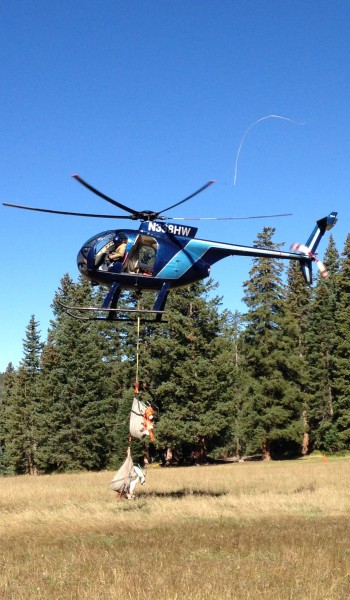
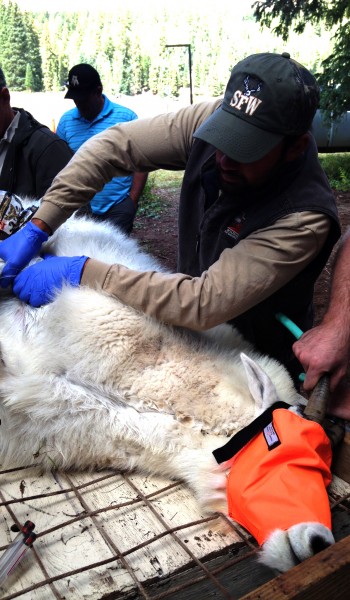
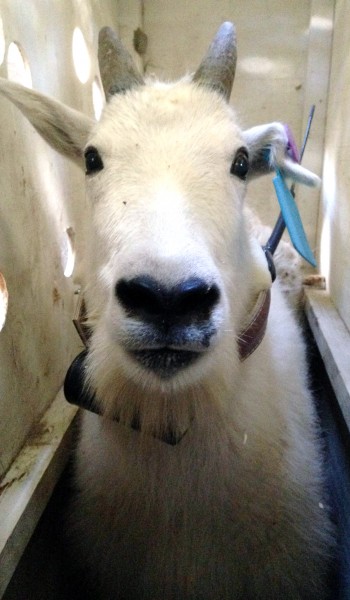
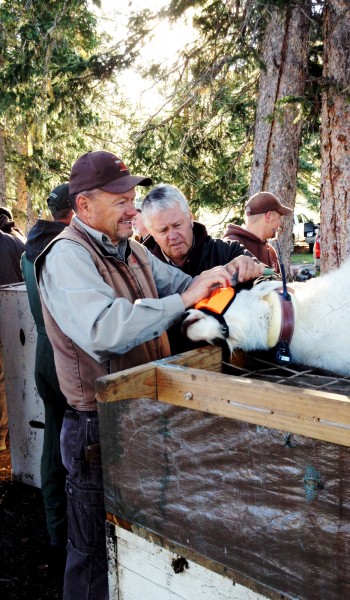
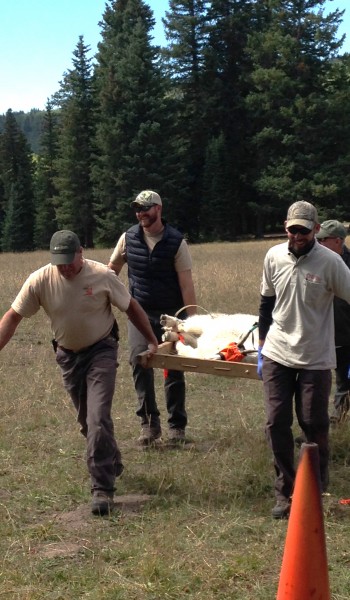
The goats – 5 billies and 10 nannies – were captured off of the Beaver Mountains, approximately 250 miles from the release site. Each goat was processed, measured and fitted with a GPS collar.
“All hands were helping as we loaded the goats into transport boxes for the ride to the La Sals,” said Bryce Pilling, SFW staff member. “These transplant projects are a unique opportunity for us to handle big game animals while working closely with DWR biologists.”
Brayden and Paula Richmond, Chairs of SFW’s Beaver Chapter, participated and also provided food for the crew of 35 people on site. SFW, Utah DWR and the US Forest Service were all represented on the mountain.
Riley Peck, DWR Southern Region Wildlife Biologist led the group effort. He said, “These goats should succeed and integrate well with 20 existing goats that were released with SFW’s help at the same location in 2013. Ultimately, we are confident these animals will establish a new, permanent herd of mountain goats here on the La Sal range.”
Big Game Management at 9,979 Feet
 The SFW Cache Team just returned from a high country ride to evaluate big game summer range conditions in remote parts of the Cache National Forest. SFW rode with Utah Division of Wildlife (DWR) big game personnel to an elevation of 9,979 feet to get a first-hand, up close look at range conditions.
 The purpose of the ride was to assess range conditions for existing Mule Deer and Elk in this high country region of northern Utah. Jason Lundahl and Steve Sorensen requested the assessment on behalf of SFW and arranged details and logistics of the ride.
“There’s a real benefit to having SFW members on the ground with DWR personnel on projects like this,” Lundahl said. “Some of the most important wildlife and habitat projects in Utah’s history have started in ways like this, on horseback and in the backcountry. This remote wilderness area is high quality big game summer habitat. We are very encouraged about the possibilities it holds for greater numbers of trophy deer, goats and elk in the near future.”
 In the group photo standing on top of the mountain from left to right is DWR Big Game Coordinator Justin Shannon, SFW Cache Member Steve Sorensen, DWR Northern Region Big Game Biologist and Assistant Wildlife Manager Darren Debloois, and SFW Cache Committee Chair Jason Lundahl. Photo courtesy of Jeff Lundahl.


